Affichage des articles dont le libellé est anglais. Afficher tous les articles

samedi 3 août 2013

Oscar Wilde and the Nest of Vipers


This series still delivers adventures. For now I have read four of them. The first described previously is The Candlelight Murders, which has been followed by The Ring of Death, The Dead Man Smile and The Nest of Vipers lastly acquired during my stay in the UK. Volumes are rather unequal in quality but attachment to characters is a motivation sufficient enough to pursue book after book.

The first three books following the same pattern and narrative construction, it is then a good surprise to discover that the The Nest of Vipers bears some original writing. There is the usual introduction of the story by Robert Sherard; there he meets Oscar Wilde after he has come out of jail to announce him his will to publish a manuscript from an adventure involving HRH The Prince of Wales (next-to-become King Edward VII, son of Queen Victoria). Sherard makes Wilde read it. At this point the reader comes and enters the story. Being at the moment only a manuscript, Brandreth has cleverly chosen to present his work as pieces: Robert's notes or Conan Doyle's, letters from husbands to wives, telegrams or extracts from diaries. In other words various documents in order to grasp hints, thoughts or facts. The reader is thus carried from a point of view to another which ads a sense of immediacy for the reader who is willingly taken into the story and in a way made to participate event though the final answers are given by Oscar, and Oscar alone, without any hint given before. Mystery must be preserved.

Reading this new adventure was somehow refreshing and to speak more about the plot in itself, it happens that The Nest of Vipers focuses on a death (not too surprisingly) in the context of hysteria, the famous nineteenth century illness. Not to mention fantasy (fangtasy if I dared) with vampires gravitating towards our heroes. Our curiosity is also arisen by the presence of the Prince of Wales. HRH involved with a death, how so? How shocking! How deliciously readable.

vendredi 1 avril 2011

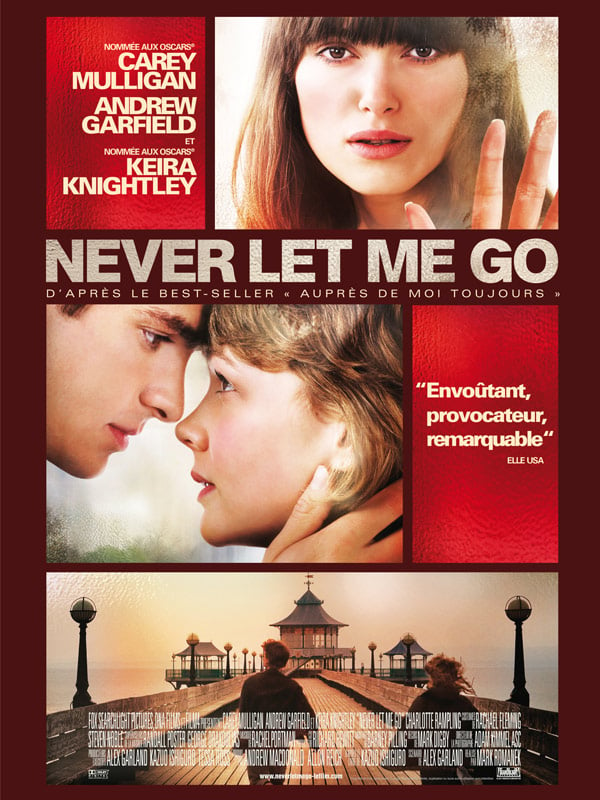
Never Let Me Go


Never Let Me Go is another novel by Kazuo Ishiguro which has turned into a film (see Remains of the Day with Emma Thompson). The production reflects the story, the sobriety with which Mark Romanek has directed this story only reinforces the beauty of it. This modest British production proves to be of quality, so much so that the cast is perfect – as well as their interpretations – and I am not afraid of these strong words when dealing with this film. I did not imagined it would give me such emotions in the end. Even outside the cinema I was not able to collect my wits.

This is the story of three young persons. Kathy, Ruth and Tommy (Carey Mulligan, Keira Knightley and Andrew Garfield) who live in a traditional British boarding school inside which they have to follow strict healthy rules, for their own good. One teacher only (Sally Hawkins) dares to explain them the true purpose of their existence, of their doings in Hailsham. In other words, they became aware of their short and doomed destiny. Three stages follow one another: young adolescence, young adulthood and confirmed adulthood where real order is restored. The lives of these three persons are, as Kathy says,“interwoven,” motivated by love and friendship. Despite these links, years have passed without their seeing each other, and yet ten years later Destiny has chosen to unite them again.

Not only destiny and free will are challenged here, but the nature of things, the ability to define oneself. Who are they? What are they exactly? Nobody could really explain it to them, nobody wanted to in fact. Kathy is the one who understands her feelings, who knows how to face life. She is the one whom we follow the tracks, sharing every one of her feelings. To me Ruth and Tommy desperately want to find a meaning to their lives without the capacity of truly reaching it. Or perhaps too late, though. The latter two have been mislead, to the great displeasure of Kathy. Revelations came too late in their existence, which only increase the cruel fate they have to confront themselves with. Ruth, a complex character, nevertheless undertakes a kind of redemption for what she has done, offering at the same time a thwarted second chance for Kathy and Tommy to live their love.

You can find on IMDB this beautiful line from Kathy:
I come here and imagine that this is the spot where everything I've lost since my childhood is washed out. I tell myself, if that were true, and I waited long enough then a tiny figure would appear on the horizon across the field and gradually get larger until I'd see it was Tommy. He'd wave. And maybe call. I don't know if the fantasy go beyond that, I can't let it. I remind myself I was lucky to have had any time with him at all. What I'm not sure about, is if our lives have been so different from the lives of the people we save. We all complete. Maybe none of us really understand what we've lived through, or feel we've had enough time.


mardi 1 mars 2011

Oscar Wilde and the Candlelight Murders


From 2007 onwards, Gyles Brandreth has begun a series of detective stories starring the famous Victorian author Oscar Wilde. Accompanied by two fellows named Robert Sherard and Arthur Conan Doyle (yes, him indeed), dear Oscar tries to solve mysteries. The books – or at least this very one – wish for faithfulness and veracity. The story is thus told by Sherard, according to the diaries he hold at the time. As being a close friend of Wilde, he presents us the man that lies behind the author, either enhanced and attacked when under trial.

In the first investigation, Oscar has to face the death of one of his friends and students, Billy Wood. He turns to Conan Doyle in search for help, and the latter directs him to a young Scotland Yard inspector named Fraser. At first, Oscar is not believed, so Sherard and him will begin to investigate by themselves. As an absolute admirer of Conan Doyle's Sherlock Holmes, Wilde constantly refers to Holmes' science of deduction and tries to think as Holmes would have think. His observations and deductions will lead to a perfect a Columbo-like disclosure. We have figured out some elements, but the best part will be revealed.

Despite the genuine interest given by this story, Brandreth leaves the reader uncertain about it. Oscar Wilde's investigation oscillates between his quest and his usual day-life during a period of several months. In other words the author alternates between long passages based on historical facts and the breathlessness of the investigation. There is too big a gap between the two. However in the end, we tend to forget these details, so much that we are eager to know the truth. In addition, Brandreth has carefully mingled Oscar Wilde's famous quotes and witticisms, to add some pleasure, authenticity and Wilde's universe to the book (what is essential!).

All in all, Gyles Brandreth is just as effective as Stephanie Barron is with her Jane Austen Mysteries. Jane Austen and Oscar Wilde are safe bets these days in the bookshelves.


Quotes :

“There is no friendship possible between men and women, Robert. Remember that. There is passion, enmity, worship, love, but no friendship.” (real quote used by Brandreth)

“why should we not joyfully admit, both od us, that there are some people – other people – we do not wish to see again? It is not ingratitude. It is not indifference. They have simply given us all they have to give and we must move on.” (sounds like a real quote)

mercredi 9 février 2011

The King's Speech


First and foremost, in passing by, I wonder why the French translation is what it actually is. Le Discours d'un roi...The King's Speech. Even though it could be whatever King, we know that speech is an issue for this King. Please, translators, explain to me how your minds do function. Let' forget this point to concentrate on the film itself.

In the thirties, England has to face the death of a King (George V, played by Micheal Gambon), the rise of Hitler and the forthcoming of another war and unfortunately for Prince Albert, Duke of York (Colin Firth), the rise of broadcasting. The second heir to the throne suffers from stammer, which scare him each time he has public duties for the crown. He has tried to cure it, but in vain. As a last resort, his always-supportive wife (Helena Bonham Carter) calls a speech therapist named Lionel Logue (Geoffrey Rush) to help “Bertie.” Logue's unorthodox methods will puzzle His Royal Highness, and yet they will prove themselves to be quite efficient. Together, as a team, as friends, they will try to overcome Bertie's stammering and his lack of confidence in himself and in his ability to be King.

I am still overflowed with emotion but I think it is legitimate considering the masterpiece I have just seen. You might say it is only because I have just seen Colin Firth but I can be trustworthy from time to time. Colin Firth gives us for sure an intense interpretation of this man whose life has been dictated by rules and harshness. This film may not entirely stick to reality, however one must admit the efficiency with which the characters are displayed, the efficiency with which the audience gets involved in the story, from the beginning to the end. You feel indeed Prince Albert's fears, pains or victories as if you were just at his place. I think that is part of the strength of this film to enable its audience such a wide range of emotion, from laughs to tears.

Tom Hooper have treated Duke of York's stammering with humility and great intensity. That does not mean that he directed a grave and serious film. It is indeed because of what is at stake to this man, a proof of his value. However there is something else, there is actually Bertie's ability to make constantly fun of his handicap, there is the support of a wife, there is a wish to a normal life. Colin Firth has again proven himself an admirable actor and above all a very moving one. Helena Bonham Carter mixes strength of mind and delicacy, and Geoffrey Rush acts, as usual, with restrain to develop all the potential of his character, sometimes friendly, sometimes fun, always willing to do the best.

This paragraph will be devoted to those of you who like-love-are crazy about the 1995 BBC version of Pride and Prejudice. Obviously you will have noticed the presence of Colin “Darcy” Firth in the film but, have you recognised Jennifer “Lizzie” Ehle as Myrtle Logue ?! I have, and I can't express how happy I was of their actual meeting near the end. Darcy and Lizzie at last together again since 1995 ! All right, I deserve what you are saying-thinking...

lundi 18 octobre 2010

You Will Meet a Tall Dark Stranger


Woody has his own cinematographic touch including original titles, a soundtrack almost missing and the film beginning in the middle of things in order to the audience to be projected among the characters. Don't be afraid the story alternates between flashbacks and present time. You will not get lost and you will not miss a thing of the plot. In addition, the stories cross over to dynamize the film..

You Will Meet a Tall Dark Stranger is above all the story of Helena (Gemma Jones, always at her best) whose husband divorce her not so long ago. The film begins by her visiting a fortune teller named Cristal. Obviously that woman is a crook, using basic playing cards to see future, telling what Helena wants and needs to hear.

From Helena we will follow as well the lives of her ex husband Alfie (Anthony Hopkins) and of their daughter Sally and her husband Roy (Naomi Watts and Josh Brolin). Alfie wishes for a new youth, her daughter's couple is on the skids due to a lack of money and a lack of pregnancy. To put it another way, Roy is a novelist with a medicine diploma who has sold one best-seller and struggles to complete his latest, leaving aside the want of his wife to become a mother.

There is also a glimpse at Sally's boss Greg's (Antonio Banderas) life who has troubles at home, just like her. No need to mention the sex appeal of this beautiful foreigner and his accent which will put Sally to a severe test as far as her faithfulness is concerned. Roy's faithfulness will also be challenged by his encounter with the red-dressed neighbour Dia (the rising Freida Pinto)

So Helena manages to move on as well as being happy again, thanks to Cristal's guidance. The latter will predict Helena's meeting with a man coined the tall dark stranger..how thrilling. Maybe.

This new born Woody Allen resembles more to a tableau than to a film. Actually there is a feeling of disappointment at the end. The story stops when the audience would have expected some more clues to solve the issues brought forward throughout the film. We have popped in and out of their lives without more information.

All in all, You Will Meet a Tall Dark Stranger is about being strong before the vagaries of life, about how to face them, what your instinct tells you to do. But our dear director is not as his best with this film. Although the plot presents very interesting elements, a feeling of déjà-vu remains. We miss the great philosophical speeches that we were glad to rediscover in Whatever Works.

vendredi 15 octobre 2010

Despicable Me


All right, he is him, ugly and mean but Despicable Me is so much more in keeping with the subject. What a shame I did not see it in English. I must admit it is hard to explain why you like a word rather than another. “Despicable”...as if meanness were felt in the syllables. Anyway.
This animated comedy tells the story of Gru (aka Steve Carell in English and the over media-friendly Gad Elmaleh in French), a criminal mastermind helped by an army of tiny yellow things called minions and an old stone deaf scientific. Gru is not actually the greatest mean guy on the planet but rather the failed criminal being now too old for sensational jobs – and his banker. New villains flourishing on the market are in fact far more rising, such as the feeble Vector is. The very one who stole one of the great pyramids of Egypt. Yes, that's true. But beware, Gru is about to set his ultimate scheme going : stealing the moon. It is not that his plan is complicated but Vector will put a spoke in his wheels. One aspect of his brilliant projects consists of adopting three young girls who sell cookies. You will know why soon enough. Nothing is perfect and these girls will change his life in a radical way for his greatest pleasure and ours at the same time. Actually, two totally different kind of stories mingle. The characters are so cute, so moving, so funny. It is impossible you remain stony-faced. I am still confused about those minions..not that funny or cute. Again the media aroused much more expectations.
Even though we can say the film lacks originality and that there has been to much advertising for what it really is, there is no way you can deny its humour and tenderness. 


vendredi 10 septembre 2010

Jasper Fforde's Thursday Next series


First of all, some explanation about Thursday's alternate universe must be provided. United Kingdom does not exists, England is a republic and the Whig Party is still in the Commons. Technologies are advanced to the point that dodos can be cloned, mammoths can live and Neanderthals have been resurrected. There is also the Goliath Corporation that has a great power and influence and that constitutes one the great enemy of Thursday and fair justice. 
 
Then there is a governmental force called the SpecOps which includes many branches that go from the “police of the police” to The ChronoGuard, the Office for Special Temporal Stability or the one that deals with vampires and werewolves. Among them stands the division in which Thursday works : Specops 27 – the literary detectives. But one question remains, who is Thursday Next ?
In 1985, Thursday, in her thirties is a former soldier in the still existing Crimean War. She is the daughter of a member of the ChronoGuard who does not exist due to his eradication, the niece of scientist whose craziness and genius reminds of Dr Emmett Brown's own genius and the future wife of a former soldier now writer who will also have his period of non-existence. Thursday becomes famous in her world when her greatest enemy Acheron Hades almost made Jane Eyre's plot collapse. Indeed, in Thursday's universe, people may travel into books thanks to her uncle Mycroft's creation : the Prose Portal. Moreover, books have their own police called Jurisfiction which is managed by characters from Literature as Miss Havisham, the abandoned bride from Dicken's Great Expectations.
Briefly, in the first volume of her adventures – The Eyre Affair - members of her family are kidnapped by Hades and entrapped into books. She eventually kills him. In the second volume – Lost in a Good Book - she becomes acquainted with Jurisficiton and learns how to be one of its agent. She also has to face the end of the world. In the third one – The Well of Lost Plots - she is pregnant, she does not remember her husband and hides in a book in the well of lost plots, a place in the fictional world, in order to remember him again. In Something Rotten, the fourth volume, Thursday brings to the real world the Shakespearian character Hamlet for an excursion and has to face a Minotaur aimed at killing her as well as a suspicious politician called Yorrick Kaine. The last volume to be found on bookshelves – First Among Sequels - sees Thursday dealing with her literary doubles as Jurisfiction potential agents, with convincing her son to be part of the ChronoGuard in order to save the future and with the group Goliath, still avid of control over the world. This was very brief and a lot of elements are missing but you can see how she has a full life.
If you liked British and American literature, you should read Fforde's novels as soon as possible. The plots refer to other literary works, tendencies and genres, as well as sub-plots or names do. But mostly Fforde's novels are filled with literary references scattered throughout the volumes. The characters may not be as developed as in great novels but Fforde's initiative is nonetheless pleasant to read. He plays with Literature and History, he has mixed up comic fantasy, detective stories and science fiction to deliver a crazily lighted and funny world in one collection. Have a nice trip in literature.


The Thursday Next Series


Nursery Crimes Division Series


    Jasper Fforde

    Jasper Fforde, an English novelist born in 1961, began a career in the film industry as focus puller, yet it seems it was not his vocation. Indeed, Mr Fforde became world-widely known only in 2001 with his first novel The Eyre Affair which actually is the first volume of his Thursday Next series. We do not have a great amount of information about his life and career, for the latter is very recent, but that he has a prolific mind full of surprises and humour.

    The Thursday Next series star the eponymous literary detective and is setted in an alternate history where the SpecOps take care of the nation, where dodos are fruits of cloning or where Goliath Corp. represents the “evil people.” Eight volumes are expected and five are currently published.
    Several sites are inspired from Thursday Universe and spread the Thursday “spirit.” You can go and see Goliath Corporation's website or even visits the SpecOps' website at 


      In the middle of Thursday Next's adventures, Fforde has built another universe and series : Nursery Crime Division with a first volume entitled The Big Over Easy, in 2005. The subject and characters are derived from The Well of Lost Plots when Thursday hides in a book and works for the Nursery Crime Division. This year Jasper Fforde has come out another book we do not know much yet whose title is Shades of Grey.

      Now Fforde kepts his readers waiting for numerous books. Unfortunately it has been said that he does not know when the sequels so much awaited will come out or even when he will write them. He leaves us on expectations, unfortunately. But in order not to leave Jasper's universe, take a look at his website at http://www.jasperfforde.com. It is original and funny, just like we may suppose he is.

      mercredi 1 septembre 2010

      Possession


      The famous novel Possession depicts the journey and investigation of Roland Michell and Maud Bailey, two English scholars attempting to discover the true story about the supposed relationship between two fictitious Victorian poets named Randolph Henry Ash and Christabel LaMotte.
      The plot is set in the second half of the 1980s. Roland is an expert in Ash, Maud in LaMotte whom she is a remote heiress. While documenting on Ash, Roland finds two mysterious drafts of letters addressed to an unknown woman. The quest for truth may now begin. It turns out that the woman in question is another poet, the secluded Christabel LaMotte. That is how Maud Bailey joins him in his quest. At first she helps him kindly but then she becomes as enthralled by this story as Roland is. They feel like possessed by this discovery, eager to know what exactly happened between the poets. While they investigate, Maud and Roland seem to get all the more closer to each other that their subjects of inquiry get acquainted whence a new bond is created between their field of studies. Roland's discovery will baffle the profession and all what has been known about either Ash/LaMotte's lives, writings or Victorian period's conceptions. As a consequence of this breakthrough, many people will get interested by the letters and soon two enemies will face : greed and integrity -or truth.

      Possession truly happens to be an amazing piece of literature doubled notwithstanding its most attractive plot for those who like either romance, literature or investigations. Antonia S. Byatt has not only interspersed Ash and LaMotte in Literature but has created a whole literary universe scattered throughout the novel. Her most impressive achievement is that she has involved in her narrative fictitious writings by these Victorian writers and also by contemporaries from both Ash/LaMotte and Roland/Maud's periods. The novel is indeed full of poems, tales, excerpts from autobiographies and diaries, and more importantly it is filled with letters standing among the “classical” narrative which are the main source of information about Ash and LaMotte. Along with this range of literary genres, the novel is partly a romance, partly a quest, partly a detective story and even involves hints at gloomy stories near the end. These genres mingled together are another proof of the literary master-handling of the author as she seems to sail from one to another without the mere difficulty. Mrs Byatt is, as I recently learned, a former lecturer in English hence her capacity to produce such works as poems or excerpts of supposed critical papers, a reading that may appear very obscure to people not accustomed to literary criticisms.
      After the coming out of her book in 1990 she was awarded the Booker Prize. As a true recognition of her work, the website The Victorian Web presents the book in an extended way with many subjects upon it. What impresses me is that this contemporary book only dating from 1990 is analyzed as one of the major novels we still study nowadays.

      The director of the brilliant Death at a Funeral Neil Labute has adapted Possession to the screen in 2002 starring Gwyneth Paltrow, Aaron Eckhart, Jennifer Ehle and Jeremy Northam as LaMotte and Ash. The novel has obviously undertaken many changes to end up in the film. Some of the scholars have thus been deleted as well as the solicitors and Roland girlfriend Val to allow, in a more easy way, the relationship between Maud and him. Besides, Roland is no longer British but American. It is a shift I do not completely understand though.
      The emphasis is made upon the love stories between each duet though there were more stakes than merely a love story in the 19th century. All the crucial elements are there, plus the fact that Maud and Roland are not that shy towards each other as in the novel. I think that the spirit of the book is luckily enough there even though it is exposed in radically a simple way. This story has enthralled me as to be as eager as our two modern heroes to know the true story of Ash and LaMotte. This movie has also moved me enough to make me want to study English and literature though at the time it was not as obvious as it is now. Now that I have read the original book, this want is increased though I can be nothing but impressed by this work.

      samedi 3 juillet 2010

      Nine


      Rob Marshall belongs to the sphere of theater, he is a theater director or choreographer. Nonetheless in 2002 he has become internationally known as a film director for the jazzy Chicago, an adaptation of the eponymous Broadway musical. Now in 2009 (2010 in France) Marshall visits again musicals and appropriates Nine which is also based on Federico Fellini's film 8 ½. Nine's cast is quite amazing, look at the poster. Isn't it attractive? Daniel Day-Lewis (Guido Contini) gives the line to no less than seven great actresses and singers. In the first scene, Overture Delle Donne, he faces all the women that are part of his life, namely

      • Marion Cotillard as his wife Luisa Contini,

      • Penélope Cruz as his mistress Clara,

      • Judi Dench as his friend and costume designer Lillie,

      • Nicole Kidman as his movie star and muse Claudia Jenssen,

      • Kate Hudson as an American journalist Stephanie,

      • Sophia Loren as his late Mamma and finally,

      • Fergie from the Black Eyed Peas music band as the whore of his childhood Saraghina.


      Nine is set in the Italy of the 1960s and tells the story of the famous Italian director Guido Contini, on the verge of making his new movie Italia. The trouble is that Signore Contini has no script and absolutely no inspiration at ten days from the beginning of the shooting. Actually Guido is, in a way, torn between his image of an adulated director and his behavior with women and especially with his wife and his lover.
      Guido has to face the production of his new movie and his lack of inspiration. Thanks to the first scene which introduces the seven women of his life we become aware of the troubles he has to deal with that can be seen as “too many women” ! More seriously I did not manage to find an explanation to this first scene. It is beautiful indeed, and introduces the whole cast but what is its exact meaning? I do not know. Throughout the movie Guido will sing and each female character will sing a customized act – two for Marion Cotillard - which is dedicated to Guido. These acts aim at inspiring him, at confronting him or at seducing him too where he stands either as a spectator or at the back, as if he were shy and curious to see what is happening. Every characters will thus have their own style from a pink seductive show to a provocative denouncing one without forgetting a comforting motherly lullaby. Here you can see a little description on these numbers
      • Marion Cotillard sings her pain at being his wife in a sober act (My Husband Makes Movies) and later sings, as if she were a temptress, her anger at him in Take It All

      • Penélope Cruz shows in a pink atmosphere the seductiveness of her character, whispering to Guido what is necessary to excite him with A Call From The Vatican

      • Judi Dench exposes her talent as a costume designer in what was the best of costumes at the Folies Bergere, the whole in a very French mood

      • Nicole Kidman does not want to be a “star” any more and most of all she wants to be herself and so sings her goodbye to Guido while giving him her last guidance to his film in an Usual Way

      • Kate Hudson plays the superficial, clothes-interested sex-emancipated American who wants Guido in her bed. Rob Marshall has written this role especially for her and has created a glamorous and rhythmic Cinema Italiano fashion show

      • Sophia Loren is the Mamma and as being dead, represents the comfort Guido needs. Her scene is likened to a lullaby entitled Guarda La Luna

      • As for Fergie, the 1920s' whore, Rob Marshall has imagined a Be Italian sandy number with chairs and numerous other female dancers. It is quite impressive an act I must confess.


      Needless to say that all these shows are the fruits of his imagination, just as his mother is, in which all is permitted to fill us with enthusiasm.

      There are mainly two streams in the criticism made about Nine that are in complete contradiction : a side admires Marshall, his aestheticism and camera style and an other clearly dislikes it and won't go back on the discussion. I must admit that Nine is not as great as Chicago was from my point of view. Some say that Nine lacks the unity Chicago had. It is true in a way and yet the numbers performed are conceived in relation with the personality of the character who sings it -and Guido's imagination too. I think that there is thus an explanation for this lack of unity as far each character's personality is concerned. Guido is searching for inspiration so he imagines different kinds of situations. It may be disturbing at first hand but if you considered the fact that each female character has its own personality as I said before, the director's choice begins to make sense and this lack becomes legitimate. Some others say that Nine's plot is uninteresting. I do not agree with this. Guido Contini faces a crisis that is common to men and artists. How to face the lack of inspiration? How to face a life of semi debauchery on the verge to collapse? And moreover how to face pressure when producers and public are so demanding? All these questions are tackled in the film. There may be no answers but only an hypothetic reaction from Guido.

      Then, Rob Marshall has quite an extraordinary sense of aestheticism. Just as in Chicago and Memoirs of a Geisha, the photography is beautiful, he knows how to amaze his audience. In this sense Nine is perhaps more spectacular than Chicago the former involving much more dancers and the scenery being more elaborate. Marshall may have not stuck to the real Italian film industry image but he has once again managed to make a film that is pleasing to the eye. However the songs are not as well written as they were in Chicago and that is a shame for sure. They express what is expected but lyrics are not as developed ; it's not as fluent as it was in Chicago. They are mostly redundant with words that come over and over again though they can be very touching.
      I will end by saying that Chicago was a jazzy, a cheerful film whereas Nine emphasizes on a more dramatic subject. The two are obviously very different and must be compared carefully. Do not be deterred from seeing it, go and make up your own opinion, or simply go and enjoy the view and the songs !

      mercredi 9 juin 2010

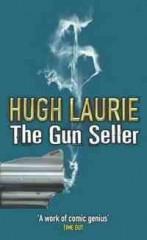
      The Gun Seller


      The Gun Seller, or how dear now world-wide famous Hugh Laurie has come out his manuscript. Thanks to the success of his American adventure House MD, we have become acquainted with another face of Hugh Laurie. He is an actor, a humorist and now a writer. More exactly he is so from 1996, but it is hard to get so widely published in France when you are almost unknown. Celebrity definitely helps. I must admit I started this book frankly biased as I have been already fond of this man for many years. But now that I have finished my reading I can say that I liked it even if some points are debatable. 

      To put it in a nutshell, Thomas Lang, a former military man and humble citizen of the crown, is at first engulfed in a story of arm dealers he does not fully understand. Then he will only act for the care of the girl he is attracted to, Sarah Woolf whose father tried to hire Thomas. And in the end, Thomas will bluff readers in his actions. Actually, Thomas has been hired to kill Alexander Woolf. Being a good man and not an assassin, he tries to find this Mr Woolf to warn him against his enemies. And from that point on will begin his adventures. All in all, he will have to deal with the American CIA, the British Department of Defense, a terrorist group and one or two influential arm dealers. 

      It is a good start but it could have been better. Easy to say, isn't it? I think that some passages are somewhat muddled. I must admit that I was quite confused and lost a few times. In some cases it is on purpose, that is for sure, and this confusion is equivalent to cinema plots when we have to wait until the end to fully understand the true part of characters. The author had many good ideas but not as well handled in the story has he could have done. He leaves sometimes the reader puzzled with his protagonist and what the latter is doing. Even though not telling much may be a good device, here this way of building his intrigue is not satisfactory enough. Apart from the plot, The Gun Seller proves to be original in Hugh Laurie's writing style. With Laurie's roles in our mind, we cannot but see his character in his writing style : witty, ironic and cynical. Everything we like nowadays. It is pleasant to read if you do not attach too much importance to details.

      mercredi 2 juin 2010

      Jack the Ripper


      This is Jack the Ripper
      Jack the Ripper
      Sent through time
      To come to kill you

      I often have in mind these parts of the song Jack the Ripper by The Servant. And I told myself “Why not.” There is Jack the Ripper the band, the song, the books, the films and now exclusively for AnglophoniZ, there will be Jack the Ripper the article. Let's take a look at this period of English History.

      London 1888, District of Whitechapel. A series of murders is the talk of the town. You are a girl at night in the East End London and you are afraid of walking alone. Your only thought is for the name on everyone's lips “Jack the Ripper.” What do you think of it as a beginning ?
      The Whitechapel Murderer,” “Leather Apron” or “Jack the Ripper” pointed at the same one person but only the last name remained in our minds. This nickname has kept all his mystery with the years and the folklore of this gruesome story has not diminished because, actually, no one has been arrested, no one knows the end of the story or even what really happened. That's the distinctive feature of this case and what makes it popular. There were so many attacks at this period that we do not know exactly how many were committed by the Ripper. However historians, policemen and pseudo detectives agree on the number of 5 victims coined the “canonical five.” There were Mary Ann “Polly” Nicholls in Buck's Row, Annie “Dark Annie” Chapman at 29 Hanbury Street, Elizabeth “Long Liz” Stride in Berner Street and Catherine Eddowes in Mitre Square and finally Mary Jane “Black Mary” Kelly at 13 Miller's Court. The five of them died between August 31st and November 9th 1888 in a square of 400 meters in the middle of this “den of immorality.” The five of them were prostitutes and not very young, except one. The mutilations increased as the murders followed on. The modus operandi of the Ripper then included deep throat slashes, genital-area and abdominal mutilation, facial mutilations and even removal of internal organs.
      As for the investigation itself, you could have said that it was a bloody mess! The newly appointed head of the Criminal Investigation Department (CID) Robert Anderson went to Switzerland very quickly when appointed to only return to England near the end of the attacks. Sir Charles Warren, the Metropolitan Police Commissioner was thus at the head of the investigation he has lead with a bad hand. For example, he ordered an important inscription to be washed away because he feared the citizens' reaction. But they have nonetheless reacted as promptly, a group of volunteer citizens, the Whitechapel Vigilance Committee, was formed because of their dissatisfaction with the police efficiency. Moreover, many letters aimed at helping the police were sent and examined whether they were useful or not.
      Media also played an important part in these events. As I said before, attacks or murders were quite common but thanks to an arousal of media, Jack the Ripper became extremely famous. Actually his nickname was introduced to people thanks to the press. The murderer was supposed to have sent letters to the people in charge with this affair. Three letters have become well known and were called the “Dear Boss” letter in which he signed “Jack the Ripper” for the first time, the “Saucy Jack” postcard and the “From Hell” letter which came with a box containing half of a kidney. However, it was later claimed that these letters were sent by a journalist avid of publicity. As you see, there is another mystery concerning this case that will not be solved.

      What if the media had not make a fuss out of these murders? Maybe our vivid imagination would not have so flourished and created so many works out of these events. What if the police has been more organise and efficient? Maybe the Ripper would have been caught. We will never know. There was – and still is - so many hypotheses, so many contradictions, so many miscarriage of justice and so many suspects that you could imagine almost what you wish. Even Queen Victoria take an interest in these events and fiercely asked her ministers to take care of it. All in all, the murders enable citizens and authority to be aware of the sanitary situation in the East End and in the decades following the murders the worst places were demolished. Now you may go to London and visit the murders sites. You too, be an expert in “ripperology” and make your own investigation.

      samedi 22 mai 2010

      Pride and Prejudice


      Maybe the most popular of the six novels, Pride and Prejudice appears at first hand as a very complex story involving “too many characters” and even “being boring”, depending on opinions. It is absolutely NOT the case! The plot must be considered into the context of the 19th century. It was initially entitled First Impressions. However after the publisher's rejection, Austen revised her manuscript to build up Pride and Prejudice as we know it today.

      The novel is mainly about two sisters, Jane and Elizabeth Bennet and how they manage to reach happiness in life and love. One day, the Bennets' routine is agitated when they hear the news that the wealthy Charles Bingley - and Co.- moves in a neighbouring place, Netherfield Park. Mrs Bennet sees automatically an opportunity to marry one of her five daughters. Marriage and social expectations were rather an important subject matter in the 19th century society, and especially to Mrs Bennet because of the entail. This was a law stating that land and money must go to a male heir. In other words, the five Bennet daughters would have nothing if their father died prematurely. When they all meet at a small ball, Charles and Jane are directly attracted to each other whereas the temporary tensions between Darcy - Bingley's closest friend - and Elizabeth begin. These tensions began when he rejected her when Bingley suggested him to dance with her. But you will see that the feelings of either Darcy and Elizabeth will change a lot as the story develops. Later, a man called Mr Collins, who is Mr Bennet's cousin and heir, visits the family and purposely wants to marry one of the five girls. He chooses Elizabeth, who refuses him. Out of pique he decides to marry Elizabeth's friend, Charlotte Lucas. From now on will begin states of frustration, love, deceptions and socially improper behaviours from which I leave details aside in order not to spoil your future reading of the book. Nevertheless it is interesting to note that in Jane Austen's novels, “all is well that ends well” as Shakespeare would have said.

      Obviously both Darcy and Elizabeth express pride and prejudice throughout the novel, just as many characters do. Darcy is proud of his social class and is prejudiced against the Bennets' conduct. Elizabeth's pride is attacked when Darcy refuses to consider her at the first ball because of her social origins and she is prejudiced against his reserved and arrogant manners that she frankly dislikes. Her prejudice against him is even more amplified when she hears about his conflict with George Wickham, a militia officer encountered in their small village. But it is mostly their first impressions that matter (and remember how the novel was entitled firstly), impressions that will be revised while all the characters will know each other better.
      To me the novel does not make a case for moral values, what you should think or not, what you should do or not. The most important feature is the way characters manage to fulfil their inmost desires. Pride and Prejudice is also a great description of the period, full of realism. One of Jane Austen's particularities was to examine what surrounded her, and thus we can find a certain verisimilitude in her novels. In addition to that, we can notice several instances of irony in the characters, in their behaviour but also in some dialogues conducted by Mr Bennet or Elizabeth for example. Hence the fact that dialogues are very important and reveal a lot about characterization. Speeches enable the reader to learn more about characters and it is a way for the reader to form his own opinion upon the situation, the characters' mind and their behaviour. We can see that this emphasis is shown right from the incipit as the novel begins with a dialogue. Moreover, Jane Austen often read her works to a restricted audience, hence the importance of the orality of her text.

      This story, though deeply rooted in a specific period of History, keeps on captivating many readers throughout the centuries. Besides, if you want to see an adaptation, I eagerly recommend that you see the one made by the BBC in 1995, which remains the one and only faithful adaptation to the novel. [Colin Firth will always be my Mr Darcy!]

      jeudi 20 mai 2010

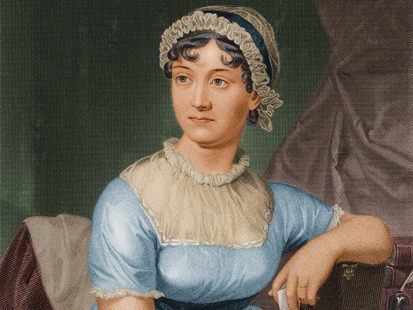
      Jane Austen


      Miss Austen now represents one of the greatest authors England has ever had. Like Shakespeare, the body of her work is constantly adapted, studied or admired. Not to mention that, these days, Jane Austen is quite a la mode. We do not have a great amount of details about her life. Most biographical information come from her own family circle, especially by the few letters her sister Cassandra left provided.
      She was born on December 16, 1775 in Hampshire and had six brothers and one sister, her closest friend, Cassandra. Apart from a brief stay at Oxford in order for Jane and Cassandra to be educated, Jane stayed within the sphere of the family and learnt almost by herself, due to a lack of money. She loved reading and began writing at an early age. Her father was willing to let his daughters write – Jane's favourite pastime- or draw – which was Cassandra's. The former liked to entertain her own family with what she wrote, letting her now famously wit appear. In 1816, Jane Austen began to be ill. It seems that she ignored her illness at first and continued her habits but her health soon declined, she had great difficulties to walk or felt more and more tired. It kept going worse and she died eventually the following year, on July 18, 1817. Contemporary scientists and descriptions of her symptoms tend to either Addison's disease, a lymphoma or a bovine tuberculosis. She remained unmarried but nonetheless experienced the feelings she describes in her novels. She left us, readers, with a legacy made up of only six novels and a few unfinished writings. She began to write them around 1796, and yet they were published more later, from 1811 onwards. The first novel to be published was Sense & Sensibility and then in 1813 Pride & Prejudice came out. Her novels deal with women, their access to happiness in love, their part in society, and also their position when confronted with the law. However, they deal with morality, temper, sometimes with the influence of a place upon its inhabitants or they can mock the society and other pieces of writings.
      Jane Austen enthralled many readers, and continues to do so. She has inspired many writers, and especially with Pride and Prejudice. Sequels or fictitious letters have been written by admirers and modern authors who wanted so much to see what could have been Elizabeth and Darcy's life after the end of the book that they imagined it. Or recently a Pride and Prejudice and Zombies and a Sense and Sensibility and Sea Monsters came out riding on the wave of Jane Austen's popularity. As for me, I have them all, or almost...

      jeudi 29 avril 2010

      [AnglophoniZ] Sherlock Holmes


      At first I did not know what to expect concerning this adaptation of Sir Arthur Conan Doyle's famous detective. The director, Guy Ritchie, had not got us used to old-England-setting productions with films such as Lock, Stock and Two Smoking Barrels (French title is Arnaques, crimes et botanique) or recently RockNRolla. Rithcie changes his style and you will be loving it ! You will probably think I am a crazy woman but I must say that I have totally recognized some part of Disney's The Great Mouse Detective (French title Basil, Détective Privé) when I went to see the new Sherlock Holmes film! And so it comforts me to see details that really define the character of Sherlock Holmes, that are obviously deductive reasoning, analyses and experiments.

      As you can see from the poster, Robert Downey Jr. holds the leading role with Jude Law on his side as Dr. Watson. The evil man of the game is this time the great Mark Strong whose voice already puts you into the dark atmosphere of this 19th century London. The character of the femme fatale is attributed to Irene Adler to whom our dear Sherlock cannot resist (Rachel McAdams, The Notebook) and the almost-nice one to the future Mrs Watson, Mary Morstan (Kelly Reilly, Pride and Prejudice, L'Auberge Espagnole). They represent the necessary touch of femininity to be found in such films where men are in the forefront.

      The story begins in the heat of battle when Holmes and Watson are just about to solve their supposed last investigation they have worked on together : they are about to beat the magician and murderer Lord Blackwood. Unfortunately after his hanging, Lord Blackwood comes back from his grave and goes further in his black designs. And thus Holmes has to hunt him again, as any self-respecting detective would do leading Watson to follow him again. The case thus involves mysteries, magic, a very dark magic indeed that threatens London's inhabitants and that drives Holmes quite baffled. He will also exceed the limits of his own understanding to, in the end, surprise everyone. Elementary my dear Watson.

      However, this Holmes-Watson duet does not look like an association of detectives that is usually seen in other adaptations or films. They rather look like two superheroes whom the police call when they are needed than two traditional detectives. Superheroes are quite fashionable indeed and flood screens for several years. For sure you will encounter in this opus many fights and imposing fights to be more precise. Take a look at the grand finale between Holmes and Lord Blackwood, you will not be disappointed. Far from the image of a clean detective always well dressed and polite in so a “British” way, this version of Holmes is dirty, messy, and he likes boxing and fighting. And yet we have access to Holmes inner character. We see that he may feel quite alone and that he may suffer from from his so-called genius. You will be a little bit surprised, but not at all dissatisfied. As far as aesthetic is concerned, Ritchie has set quite an good representation of the Victorian atmosphere. He has perfectly recreated a London in industrial expansion, an overcrowded London with streets that are mostly dirt roads.
      Robert Downey Jr and Jude Law are clever, good-looking, entertaining, in other words they are perfectly matched and prove that Ritchie has made the right choice in his cast. You will have a great time seeing this film and that is how it is supposed to be, that is how you are supposed to react with a blockbuster like this. There is no need to say how eager I am to follow their adventures in further films.

      samedi 3 avril 2010

      [AnglophoniZ] Shakespeare on screen


      The body of Shakespeare's work is an extended compilation of comedies, tragedies or even tragicomedies. As his work is so vast and remarkable, it is no surprise that film screen has adopted this author. Everybody knows Shakespeare's plays, Everybody saw at least one film in which Shakespeare is mentioned. And that is the subject matter of this article. I have recollected, from my point of view, three main categories that involve Shakespeare and Shakespearian drama on screen. First, there are the classical adaptations of Shakespeare's plays. Then, the ones that take place at this period and in which Shakespeare takes an important part and finally a little category, the adaptation of Shakespearian drama into teen films.

      Fortunately (what about creativity?) many directors stick to a kind of traditional adaptation of Shakespeare's work. They stay more or less in the same period, in the same setting. For the love of this work, why changing it?! Do you know Kenneth Branagh? I'm sure you do. He is the most famous adaptor of Shakespeare's plays. He directed (and played in) 5 adaptations that are : Henri V in 1989, Much ado about nothing in 1993, Hamlet in 1996, Love's Labour Lost in 2000 and As You Like It in 2006. The two most famous films are actually Much Ado About Nothing and Hamlet. Branagh achieved a true recognition through these two. The text is greatly adapted and all of them movies are pleasant to watch. So is the case of A Midsummer Night's Dream with Kevin Kline, Christian Bale and even Sophie Marceau. All the faerie has been kept, just like the text. However, Baz Lhurmann -known for his visual deliriums- managed to mingle classical text and modern times with Romeo + Juliet that is just as beautiful as the play and just as surprising as we could have thought from such an extravagant director.

      Then I thought it would be nice to focus on some films that are (more or less) not Shakespeare's plays but that involve him a great deal. The first one I will mention is Shakespeare in Love, Oscar winner in seven categories including Best Movie in 1998. It tells the story of William Shakespeare at the time when he wrote Romeo and Juliet. We can thus follow his supposed love story with a woman that inspired him this very play and The Twelfth Night. You will be delighted by this love story in which settings are beautiful and in which Joseph Fiennes and Gwyneth Paltrow are just...perfectly matched. Now comes the time we turn towards Stage Beauty. This film talks about the time when women took their own characters on stage as formerly only men were able to act on stage. Shakespeare is quite at the centre of the film as his play Othello is a leitmotiv in it. Even though Shakespeare or his plays are not really its main subject, it sets a good portrait of the period we are plunged into and how was drama at the time.

      One funny thing concerning adaptations is that you can make almost what you want with a story. Thus it becomes quite usual to see classics turned into “teen movies”. And so it is with Shakespeare. The well known and terrific Ten things I hate about you -or at least it is in my circle of friends- is adapted from The Taming of the Shrew. I haven't read it but you must be sure that the essential is there in order to the original play to be recognize. “The main plot depicts the courtship of Petruchio, a gentleman of Verona, and Katherina, the headstrong, obdurate shrew. Initially, Katherina is an unwilling participant in the relationship, but Petruchio tempers her with various psychological torments – the "taming" – until she is an obedient bride. The sub-plot features a competition between the suitors of Katherina's less intractable sister, Bianca” Obviously it is, even names are kept unchanged! But keep in mind that “teen movie” here does not mean inconsistent or vulgar. When there is a certain amount of faithfulness, it is a great way to increase young people's awareness to classics ; even more that this one is a comedy. There is also O, obviously an Othello in modern times, far more a darker story as you will remember that went unnoticed.

      I will end this article by saying that all of the adaptations; faithful to the text or transposed into teenage stories, are a great opportunity to become acquainted with Shakespeare. For those who do not like to go to theatre it is quite a good alternative. Moreover it allows directors a great amount of technical possibilities as there are not restricted to a stage to adapt a play.


      jeudi 25 mars 2010

      [AnglophoniZ] Lolita


      Did you know that the best-seller of Vladimir Nabokov almost never reached our bookshelves as the author himself wanted to burn his work? Fortunately it has been saved by his beloved wife Vera, his muse – and driver. After many editors refused to publish Lolita, it has eventually been accepted by a French editor, Olympia Press, in 1955 and in the United States in 1958.

      I purposely won't give too much information, not to spoil you the novel. I hope you'll forgive my short summary. Actually Lolita is not the story of a girl. More precisely it's not entirely the story of a girl named Lolita but rather that of a man, Humbert Humbert, obsessed with a girl, Dolores “Lolita” Haze. Humbert or “H.H” presents himself as the author of his own memoir. In this way, we readers will be given facts from his point of view, from his own perspective and subjectivity. And that's interesting! The particularity of Lolita is that, actually, Humbert is in his forties and that Lolita is hardly an adolescent. She is, as he coined it, a “nymphet.” You can easily imagine how shocking it was at the time... Basically, the educated European H.H goes to America and moves in at the Hazes' and meets Lolita there. From then on, H.H will develop an obsession for the seductive girl, to even marry the mother in order to get closer to the daughter. But Charlotte Haze will soon die in a car accident. H.H, as a cautious stepfather, takes the - easy - decision to take care of Lolita and together they will drive throughout the United States. That's the beginning of games of manipulation and sexual intercourse leading to a strange relationship between the two. Eventually the story will end with Lolita taking flight from H.H with the help of another man. In short.
      To put it in a nutshell, H.H seems to corrupt a young and nice girl, or isn't it rather the opposite? What would you be capable of when blinded by love ?

      Lolita is thus presented as the memoir of a man, Humbert Humbert who has written “the confession of a white widowed male”, which is actually the subtitle of the novel. The foreword written by John Ray, Jr directly invites the reader in the text by telling the practical facts : who, where, when, why and how they end up. Of course it is all mockery, John Ray does not exist, and neither does Humbert nor Lolita.
      Highly controversial a novel, Lolita is nonetheless one of the greatest literary work of the twentieth century. Nabokov managed to manipulate the reader and even forced him to re-read his work so as to fully understand all the tricks he has put in it. Lolita is not simply a novel, it is not an easy novel either. Lolita is a story of love, of passion, of destruction. It compares Europe and America and introduces the doppelgänger theme (indeed, there are one or two examples of doubles in the novel). Lolita is also a detective story, including clues scattered throughout the plot. We readers are detectives who are eager to collect them and to solve the puzzle Nabokov displays in front of us. Moreover, Humbert Humbert is so persuasive and gifted that we are nearly bound to love this character that decency would suggest us to hate. His “fancy prose style” as he says seduces and even elates us hence the sense of manipulation that it conveys.

      Seven years later, Stanley Kubrick completed to immortalize Lolita (and Lolita) with the release of an eponymous adaptation, quite close to the novel but not as crude as the novel. As a last proof of the book's success, “lolita” is now a word commonly used that, according to dictionary, defines “a sexually precocious young girl.”

      jeudi 18 mars 2010

      [AnglophoniZ] Mary and Max


      Have you ever dreamt of having a foreign pen-pal ?

      In the seventies, Mary Daisy Dinkle, an Australian 8-year-old girl with a birthmark the colour of poo, would like a real friend who isn't made out of seashells or chicken bones and also would like to know where do babies come from in America as she already knows that in Australia they come from beers as her grandpoppy Ralph told her. One day while shopping with her mother she finds a New York phone book. She picks a name, totally at random and decides she will write to this person. Mary starts her letter. Fortunately he will answer and tell about his life : the friendship of Mary and Max begins.
      Her fortune pen-pal is named Max Jerry Horowitz. He is an atheistic Jewish in his forties. Over-weighed, he suffers from the Asperger's Syndrome and a goldfish named Henry VIII – of course, many Henrys will live with Max. Finally, he is affected with an addiction to chocolate hot-dogs (a recipe of his own). He wants a friend who isn't invisible as his sits in the corner of the apartment reading books.
      Contrary to Max who is single and alone in a huge city, Mary is rather surrounded : she has an alcoholic kleptomaniac mother, a distant taxidermist father or an agoraphobic old legless neighbour in a wheel-chair.
      Mary and Max's friendship will last for twenty years and won't be free from difficulties especially on the part of Max, stressed and confused by each letter Mary sends him which reminds him of periods or events he wishes to forget. Two significant parts of the movie will coincide with the committal of Max for 8 months and the attempt from Mary to help Max and his Asperger Syndrome by a book that will turn to be catastrophic in their relationship, introducing the suicide and depression themes.

      Mary as an adult is played by the Australian Toni « Muriel » Colette (from PJ Hogan's Muriel's Wedding) and Max by the Oscar winner Philip Seymour Hoffman (Truman Capote). To add to the Australian spirit of the film, Eric Bana (Troy, Hulk) plays Mary's husband to be Damian.
      The Australian Oscar Winner for Best Short Animated Film Adam Elliot wrote and directed this animated film made with modeling clay with some astounding details. Mary and Max deals with various subjects such as friendship, suicide attempt, love, the Asperger's Syndrome or the gap between NYC and Australia. Just a simple reminder concerning the former : people affected by this syndrome show disorders such as significant difficulties in social interaction.
      All in all Mary and Max uses an apparently light way to depict some serious subjects. Indeed, I say apparently because you will not take your little girl or your nephew to see it ! It is full of grey, of brown and that is not likely to please children. No, this movie is aimed at an adult public which may even be disturbed by a few scenes, and yet it involves parts that are funny and sweet. Moreover, the clay seems to attenuate what is happening and thus adds another dimension to the movie. If it were not in clay, the story and the direction would be very dark and disturbing.

      Now animation is more and more chosen to deal with serious subject matters as in $9,99, another Australian clay-movie whose subject is the meaning of life.