jeudi 20 mai 2010

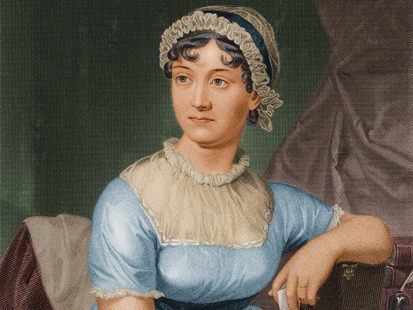
Jane Austen


Miss Austen now represents one of the greatest authors England has ever had. Like Shakespeare, the body of her work is constantly adapted, studied or admired. Not to mention that, these days, Jane Austen is quite a la mode. We do not have a great amount of details about her life. Most biographical information come from her own family circle, especially by the few letters her sister Cassandra left provided.
She was born on December 16, 1775 in Hampshire and had six brothers and one sister, her closest friend, Cassandra. Apart from a brief stay at Oxford in order for Jane and Cassandra to be educated, Jane stayed within the sphere of the family and learnt almost by herself, due to a lack of money. She loved reading and began writing at an early age. Her father was willing to let his daughters write – Jane's favourite pastime- or draw – which was Cassandra's. The former liked to entertain her own family with what she wrote, letting her now famously wit appear. In 1816, Jane Austen began to be ill. It seems that she ignored her illness at first and continued her habits but her health soon declined, she had great difficulties to walk or felt more and more tired. It kept going worse and she died eventually the following year, on July 18, 1817. Contemporary scientists and descriptions of her symptoms tend to either Addison's disease, a lymphoma or a bovine tuberculosis. She remained unmarried but nonetheless experienced the feelings she describes in her novels. She left us, readers, with a legacy made up of only six novels and a few unfinished writings. She began to write them around 1796, and yet they were published more later, from 1811 onwards. The first novel to be published was Sense & Sensibility and then in 1813 Pride & Prejudice came out. Her novels deal with women, their access to happiness in love, their part in society, and also their position when confronted with the law. However, they deal with morality, temper, sometimes with the influence of a place upon its inhabitants or they can mock the society and other pieces of writings.
Jane Austen enthralled many readers, and continues to do so. She has inspired many writers, and especially with Pride and Prejudice. Sequels or fictitious letters have been written by admirers and modern authors who wanted so much to see what could have been Elizabeth and Darcy's life after the end of the book that they imagined it. Or recently a Pride and Prejudice and Zombies and a Sense and Sensibility and Sea Monsters came out riding on the wave of Jane Austen's popularity. As for me, I have them all, or almost...

jeudi 29 avril 2010

[AnglophoniZ] Sherlock Holmes


At first I did not know what to expect concerning this adaptation of Sir Arthur Conan Doyle's famous detective. The director, Guy Ritchie, had not got us used to old-England-setting productions with films such as Lock, Stock and Two Smoking Barrels (French title is Arnaques, crimes et botanique) or recently RockNRolla. Rithcie changes his style and you will be loving it ! You will probably think I am a crazy woman but I must say that I have totally recognized some part of Disney's The Great Mouse Detective (French title Basil, Détective Privé) when I went to see the new Sherlock Holmes film! And so it comforts me to see details that really define the character of Sherlock Holmes, that are obviously deductive reasoning, analyses and experiments.

As you can see from the poster, Robert Downey Jr. holds the leading role with Jude Law on his side as Dr. Watson. The evil man of the game is this time the great Mark Strong whose voice already puts you into the dark atmosphere of this 19th century London. The character of the femme fatale is attributed to Irene Adler to whom our dear Sherlock cannot resist (Rachel McAdams, The Notebook) and the almost-nice one to the future Mrs Watson, Mary Morstan (Kelly Reilly, Pride and Prejudice, L'Auberge Espagnole). They represent the necessary touch of femininity to be found in such films where men are in the forefront.

The story begins in the heat of battle when Holmes and Watson are just about to solve their supposed last investigation they have worked on together : they are about to beat the magician and murderer Lord Blackwood. Unfortunately after his hanging, Lord Blackwood comes back from his grave and goes further in his black designs. And thus Holmes has to hunt him again, as any self-respecting detective would do leading Watson to follow him again. The case thus involves mysteries, magic, a very dark magic indeed that threatens London's inhabitants and that drives Holmes quite baffled. He will also exceed the limits of his own understanding to, in the end, surprise everyone. Elementary my dear Watson.

However, this Holmes-Watson duet does not look like an association of detectives that is usually seen in other adaptations or films. They rather look like two superheroes whom the police call when they are needed than two traditional detectives. Superheroes are quite fashionable indeed and flood screens for several years. For sure you will encounter in this opus many fights and imposing fights to be more precise. Take a look at the grand finale between Holmes and Lord Blackwood, you will not be disappointed. Far from the image of a clean detective always well dressed and polite in so a “British” way, this version of Holmes is dirty, messy, and he likes boxing and fighting. And yet we have access to Holmes inner character. We see that he may feel quite alone and that he may suffer from from his so-called genius. You will be a little bit surprised, but not at all dissatisfied. As far as aesthetic is concerned, Ritchie has set quite an good representation of the Victorian atmosphere. He has perfectly recreated a London in industrial expansion, an overcrowded London with streets that are mostly dirt roads.
Robert Downey Jr and Jude Law are clever, good-looking, entertaining, in other words they are perfectly matched and prove that Ritchie has made the right choice in his cast. You will have a great time seeing this film and that is how it is supposed to be, that is how you are supposed to react with a blockbuster like this. There is no need to say how eager I am to follow their adventures in further films.

samedi 3 avril 2010

[AnglophoniZ] Shakespeare on screen


The body of Shakespeare's work is an extended compilation of comedies, tragedies or even tragicomedies. As his work is so vast and remarkable, it is no surprise that film screen has adopted this author. Everybody knows Shakespeare's plays, Everybody saw at least one film in which Shakespeare is mentioned. And that is the subject matter of this article. I have recollected, from my point of view, three main categories that involve Shakespeare and Shakespearian drama on screen. First, there are the classical adaptations of Shakespeare's plays. Then, the ones that take place at this period and in which Shakespeare takes an important part and finally a little category, the adaptation of Shakespearian drama into teen films.

Fortunately (what about creativity?) many directors stick to a kind of traditional adaptation of Shakespeare's work. They stay more or less in the same period, in the same setting. For the love of this work, why changing it?! Do you know Kenneth Branagh? I'm sure you do. He is the most famous adaptor of Shakespeare's plays. He directed (and played in) 5 adaptations that are : Henri V in 1989, Much ado about nothing in 1993, Hamlet in 1996, Love's Labour Lost in 2000 and As You Like It in 2006. The two most famous films are actually Much Ado About Nothing and Hamlet. Branagh achieved a true recognition through these two. The text is greatly adapted and all of them movies are pleasant to watch. So is the case of A Midsummer Night's Dream with Kevin Kline, Christian Bale and even Sophie Marceau. All the faerie has been kept, just like the text. However, Baz Lhurmann -known for his visual deliriums- managed to mingle classical text and modern times with Romeo + Juliet that is just as beautiful as the play and just as surprising as we could have thought from such an extravagant director.

Then I thought it would be nice to focus on some films that are (more or less) not Shakespeare's plays but that involve him a great deal. The first one I will mention is Shakespeare in Love, Oscar winner in seven categories including Best Movie in 1998. It tells the story of William Shakespeare at the time when he wrote Romeo and Juliet. We can thus follow his supposed love story with a woman that inspired him this very play and The Twelfth Night. You will be delighted by this love story in which settings are beautiful and in which Joseph Fiennes and Gwyneth Paltrow are just...perfectly matched. Now comes the time we turn towards Stage Beauty. This film talks about the time when women took their own characters on stage as formerly only men were able to act on stage. Shakespeare is quite at the centre of the film as his play Othello is a leitmotiv in it. Even though Shakespeare or his plays are not really its main subject, it sets a good portrait of the period we are plunged into and how was drama at the time.

One funny thing concerning adaptations is that you can make almost what you want with a story. Thus it becomes quite usual to see classics turned into “teen movies”. And so it is with Shakespeare. The well known and terrific Ten things I hate about you -or at least it is in my circle of friends- is adapted from The Taming of the Shrew. I haven't read it but you must be sure that the essential is there in order to the original play to be recognize. “The main plot depicts the courtship of Petruchio, a gentleman of Verona, and Katherina, the headstrong, obdurate shrew. Initially, Katherina is an unwilling participant in the relationship, but Petruchio tempers her with various psychological torments – the "taming" – until she is an obedient bride. The sub-plot features a competition between the suitors of Katherina's less intractable sister, Bianca” Obviously it is, even names are kept unchanged! But keep in mind that “teen movie” here does not mean inconsistent or vulgar. When there is a certain amount of faithfulness, it is a great way to increase young people's awareness to classics ; even more that this one is a comedy. There is also O, obviously an Othello in modern times, far more a darker story as you will remember that went unnoticed.

I will end this article by saying that all of the adaptations; faithful to the text or transposed into teenage stories, are a great opportunity to become acquainted with Shakespeare. For those who do not like to go to theatre it is quite a good alternative. Moreover it allows directors a great amount of technical possibilities as there are not restricted to a stage to adapt a play.


jeudi 25 mars 2010

[AnglophoniZ] Lolita


Did you know that the best-seller of Vladimir Nabokov almost never reached our bookshelves as the author himself wanted to burn his work? Fortunately it has been saved by his beloved wife Vera, his muse – and driver. After many editors refused to publish Lolita, it has eventually been accepted by a French editor, Olympia Press, in 1955 and in the United States in 1958.

I purposely won't give too much information, not to spoil you the novel. I hope you'll forgive my short summary. Actually Lolita is not the story of a girl. More precisely it's not entirely the story of a girl named Lolita but rather that of a man, Humbert Humbert, obsessed with a girl, Dolores “Lolita” Haze. Humbert or “H.H” presents himself as the author of his own memoir. In this way, we readers will be given facts from his point of view, from his own perspective and subjectivity. And that's interesting! The particularity of Lolita is that, actually, Humbert is in his forties and that Lolita is hardly an adolescent. She is, as he coined it, a “nymphet.” You can easily imagine how shocking it was at the time... Basically, the educated European H.H goes to America and moves in at the Hazes' and meets Lolita there. From then on, H.H will develop an obsession for the seductive girl, to even marry the mother in order to get closer to the daughter. But Charlotte Haze will soon die in a car accident. H.H, as a cautious stepfather, takes the - easy - decision to take care of Lolita and together they will drive throughout the United States. That's the beginning of games of manipulation and sexual intercourse leading to a strange relationship between the two. Eventually the story will end with Lolita taking flight from H.H with the help of another man. In short.
To put it in a nutshell, H.H seems to corrupt a young and nice girl, or isn't it rather the opposite? What would you be capable of when blinded by love ?

Lolita is thus presented as the memoir of a man, Humbert Humbert who has written “the confession of a white widowed male”, which is actually the subtitle of the novel. The foreword written by John Ray, Jr directly invites the reader in the text by telling the practical facts : who, where, when, why and how they end up. Of course it is all mockery, John Ray does not exist, and neither does Humbert nor Lolita.
Highly controversial a novel, Lolita is nonetheless one of the greatest literary work of the twentieth century. Nabokov managed to manipulate the reader and even forced him to re-read his work so as to fully understand all the tricks he has put in it. Lolita is not simply a novel, it is not an easy novel either. Lolita is a story of love, of passion, of destruction. It compares Europe and America and introduces the doppelgänger theme (indeed, there are one or two examples of doubles in the novel). Lolita is also a detective story, including clues scattered throughout the plot. We readers are detectives who are eager to collect them and to solve the puzzle Nabokov displays in front of us. Moreover, Humbert Humbert is so persuasive and gifted that we are nearly bound to love this character that decency would suggest us to hate. His “fancy prose style” as he says seduces and even elates us hence the sense of manipulation that it conveys.

Seven years later, Stanley Kubrick completed to immortalize Lolita (and Lolita) with the release of an eponymous adaptation, quite close to the novel but not as crude as the novel. As a last proof of the book's success, “lolita” is now a word commonly used that, according to dictionary, defines “a sexually precocious young girl.”

jeudi 18 mars 2010

[AnglophoniZ] Mary and Max


Have you ever dreamt of having a foreign pen-pal ?

In the seventies, Mary Daisy Dinkle, an Australian 8-year-old girl with a birthmark the colour of poo, would like a real friend who isn't made out of seashells or chicken bones and also would like to know where do babies come from in America as she already knows that in Australia they come from beers as her grandpoppy Ralph told her. One day while shopping with her mother she finds a New York phone book. She picks a name, totally at random and decides she will write to this person. Mary starts her letter. Fortunately he will answer and tell about his life : the friendship of Mary and Max begins.
Her fortune pen-pal is named Max Jerry Horowitz. He is an atheistic Jewish in his forties. Over-weighed, he suffers from the Asperger's Syndrome and a goldfish named Henry VIII – of course, many Henrys will live with Max. Finally, he is affected with an addiction to chocolate hot-dogs (a recipe of his own). He wants a friend who isn't invisible as his sits in the corner of the apartment reading books.
Contrary to Max who is single and alone in a huge city, Mary is rather surrounded : she has an alcoholic kleptomaniac mother, a distant taxidermist father or an agoraphobic old legless neighbour in a wheel-chair.
Mary and Max's friendship will last for twenty years and won't be free from difficulties especially on the part of Max, stressed and confused by each letter Mary sends him which reminds him of periods or events he wishes to forget. Two significant parts of the movie will coincide with the committal of Max for 8 months and the attempt from Mary to help Max and his Asperger Syndrome by a book that will turn to be catastrophic in their relationship, introducing the suicide and depression themes.

Mary as an adult is played by the Australian Toni « Muriel » Colette (from PJ Hogan's Muriel's Wedding) and Max by the Oscar winner Philip Seymour Hoffman (Truman Capote). To add to the Australian spirit of the film, Eric Bana (Troy, Hulk) plays Mary's husband to be Damian.
The Australian Oscar Winner for Best Short Animated Film Adam Elliot wrote and directed this animated film made with modeling clay with some astounding details. Mary and Max deals with various subjects such as friendship, suicide attempt, love, the Asperger's Syndrome or the gap between NYC and Australia. Just a simple reminder concerning the former : people affected by this syndrome show disorders such as significant difficulties in social interaction.
All in all Mary and Max uses an apparently light way to depict some serious subjects. Indeed, I say apparently because you will not take your little girl or your nephew to see it ! It is full of grey, of brown and that is not likely to please children. No, this movie is aimed at an adult public which may even be disturbed by a few scenes, and yet it involves parts that are funny and sweet. Moreover, the clay seems to attenuate what is happening and thus adds another dimension to the movie. If it were not in clay, the story and the direction would be very dark and disturbing.

Now animation is more and more chosen to deal with serious subject matters as in $9,99, another Australian clay-movie whose subject is the meaning of life.